From The Garden of The Mathnawi: Tears of the Heart: Rumi Selections
About The Book
The honorable Mathnawi, composed more than seven hundred years ago by master Rumi in a vast state of love and ecstasy, has indeed come to occupy a unique place in the hearts of those searching for the Divine.
Just as the heart of a friend of Allah may not decay after death, so too those works of art that have emanated from such an incorrupt heart are immortal. After passing away, people with such refined hearts continue to live among us as they perform their services in the spiritual world. Their longevity transcends that of those who live only physically. Even if the transient physical bodies of their authors decompose in the grave and turn into dust, the works of their hearts, imbued with the fragrance of the eternal, will survive until the Day of Judgment.
Approaching the presence of the Lord through such spiritual fortune is only possible for those who have kept worldliness outside of their hearts; have not been enslaved by fame; and have totally submitted to the Divine will. The great master Rumi and his works, which are emanations from his heart, must be viewed in this manner.
Indeed, the Mathnawi is an ocean of bottomless depth with boundless meaning and uncountable secrets. Few books can be found that explain the Sufi doctrine in such detail. Through his use of stories, spiritual subjects difficult to comprehend by the mind are able to deeply penetrate the heart of the reader.
Commentators have written of the Mathnawi:
“The Qur’an begins with the command ‘Read!’ while the Mathnawi begins with the command ‘Listen!’ The latter is an explanation of the former. We are told: ‘Listen to the divine word! Listen to its secrets! Listen to the truth hidden within you!’” In other words, breezes emanating from the Mathnawi, originating in the truth and secrets of the glorious Qur’an, fan the fire of spiritual love in the hearts of students on the spiritual path.
The Mathnawi is a poetic embodiment of Rumi’s inner world reflected in couplets and is a book of rich blessing filled with great gifts of fortune. Although an esoteric account of the divine journey Rumi began under the supervision of Shams al-Tabrizi, it has nevertheless been written according to the needs and degree of understanding of ordinary people. It is a record of unceasing cries and tears borne of his inner suffering traceable to the loss of his teacher Shams and his subsequent inability to find anyone suitable with whom to share his spiritual struggles.
The great master Rumi has described the Mathnawi as follows:
“The Mathnawi is a path of light for those who want to attain the Truth, understand divine secrets, and become familiar with them.”
These expressions give us a taste for the depth of enthusiasm and joy emanating from his servanthood to Allah. As an extension of this, let us not fail to remember that Allah the Almighty has revealed His aim in the creation of man as follows:
“I have only created Jinns and human beings so that they may serve me” (Zariyat, 56).
The Mathnawi is a conversation between Rumi and his student Husameddin. It opens through his contact with Husameddin and by virtue of their association moves forward. If one were to depart, the current flowing between them would cease to circulate. When they would re-unite, their hearts would once again be swollen with currents of spiritual joy and the couplets would again flow.
The great master Rumi quddisa sirruh said: “I composed this Mathnawi in such a way that it suits Husameddin.” This statement is actually a lament for not being able to express his secret as his heart desired due to the loss of the ocean of love named Shams. Had Rumi written the Mathnawi as a conversation with Shams, who knows what great secrets would have manifested in its couplets through the burning songs that would have erupted from it?
Fariduddin Attar, may Allah be pleased with him, resembles Rumi in his vision of life. He too was in distress for not being able to find someone who could understand him. His words below express their mutually common state:
I was a bird. I flew from the world of secrets. My purpose was to take a prey up with me (i.e. find a friend who could understand my secret). Unfortunately, I could not find anyone familiar with secrets. I returned through the same door I had used to enter.
*
The great master Rumi quddisa sirruh has told hundreds of stories that are intertwined with one another. His purpose has been to lead us into drawing lessons from them through our spontaneous application of reason and our construction of analogies. In other words, he has succeeded in making subjects well beyond the reach of our rational minds comprehensible in an experiential manner. Consequently, his purpose transcends the mere transmission of legends. He has explained this as follows:
“The purpose is to draw lessons from stories, not to tell tales….”
Rumi conveys his admonitions, advice, and warnings in the form of stories. Therefore, his desire is for his audience to understand deeply the truth and spirit underlying them.
O brother and sister! The story resembles the husk while the meaning resembles the kernel of wheat inside it. The intelligent person consumes and digests the wheat, without being distracted by the husk!
Listen to the outer aspect of the story but make sure that you know how to separate the wheat from the chaff.
My words are never pointless tales. Think about them; they reflect our current state.
One may clearly understand from these statements that there are many deep lessons and messages to be gleaned from the stories Rumi has told. For this reason, one should always strive to understand the inner meanings without being distracted by the vehicles used to articulate them.
Rumi quddisa sirruh has also explained that the purification of one’s heart is only possible through association with a perfectly qualified teacher who, being an heir to Prophet Muhammad sallallahu alaihi wa sallam is capable of such a spiritual transmission. He stresses that without overcoming the obstacle of the ego, external knowledge cannot be realized as internal wisdom. Likewise, without attaining to this one can understand neither the purpose of our creation nor the honor of our existence, and finally without this one cannot discover his inner essence. Protection from the evils of the ego requires that one be able to know himself through the realization of his nothingness before the divine glory, and through discovering that the journey to Allah can be carried out only by virtue of an internal life based on divine love.
The great master Rumi illustrates unpracticed external knowledge as follows: “To be sure, good words that are not put into practice are as but a beautifully decorated but unbecoming, temporarily owned dress."
Product Information
Product Information
Shipping & Returns
Shipping & Returns
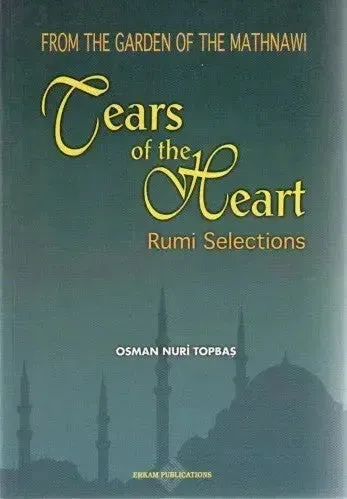
From The Garden of The Mathnawi: Tears of the Heart: Rumi Selections
From The Garden of The Mathnawi: Tears of the Heart: Rumi Selections
About The Book
The honorable Mathnawi, composed more than seven hundred years ago by master Rumi in a vast state of love and ecstasy, has indeed come to occupy a unique place in the hearts of those searching for the Divine.
Just as the heart of a friend of Allah may not decay after death, so too those works of art that have emanated from such an incorrupt heart are immortal. After passing away, people with such refined hearts continue to live among us as they perform their services in the spiritual world. Their longevity transcends that of those who live only physically. Even if the transient physical bodies of their authors decompose in the grave and turn into dust, the works of their hearts, imbued with the fragrance of the eternal, will survive until the Day of Judgment.
Approaching the presence of the Lord through such spiritual fortune is only possible for those who have kept worldliness outside of their hearts; have not been enslaved by fame; and have totally submitted to the Divine will. The great master Rumi and his works, which are emanations from his heart, must be viewed in this manner.
Indeed, the Mathnawi is an ocean of bottomless depth with boundless meaning and uncountable secrets. Few books can be found that explain the Sufi doctrine in such detail. Through his use of stories, spiritual subjects difficult to comprehend by the mind are able to deeply penetrate the heart of the reader.
Commentators have written of the Mathnawi:
“The Qur’an begins with the command ‘Read!’ while the Mathnawi begins with the command ‘Listen!’ The latter is an explanation of the former. We are told: ‘Listen to the divine word! Listen to its secrets! Listen to the truth hidden within you!’” In other words, breezes emanating from the Mathnawi, originating in the truth and secrets of the glorious Qur’an, fan the fire of spiritual love in the hearts of students on the spiritual path.
The Mathnawi is a poetic embodiment of Rumi’s inner world reflected in couplets and is a book of rich blessing filled with great gifts of fortune. Although an esoteric account of the divine journey Rumi began under the supervision of Shams al-Tabrizi, it has nevertheless been written according to the needs and degree of understanding of ordinary people. It is a record of unceasing cries and tears borne of his inner suffering traceable to the loss of his teacher Shams and his subsequent inability to find anyone suitable with whom to share his spiritual struggles.
The great master Rumi has described the Mathnawi as follows:
“The Mathnawi is a path of light for those who want to attain the Truth, understand divine secrets, and become familiar with them.”
These expressions give us a taste for the depth of enthusiasm and joy emanating from his servanthood to Allah. As an extension of this, let us not fail to remember that Allah the Almighty has revealed His aim in the creation of man as follows:
“I have only created Jinns and human beings so that they may serve me” (Zariyat, 56).
The Mathnawi is a conversation between Rumi and his student Husameddin. It opens through his contact with Husameddin and by virtue of their association moves forward. If one were to depart, the current flowing between them would cease to circulate. When they would re-unite, their hearts would once again be swollen with currents of spiritual joy and the couplets would again flow.
The great master Rumi quddisa sirruh said: “I composed this Mathnawi in such a way that it suits Husameddin.” This statement is actually a lament for not being able to express his secret as his heart desired due to the loss of the ocean of love named Shams. Had Rumi written the Mathnawi as a conversation with Shams, who knows what great secrets would have manifested in its couplets through the burning songs that would have erupted from it?
Fariduddin Attar, may Allah be pleased with him, resembles Rumi in his vision of life. He too was in distress for not being able to find someone who could understand him. His words below express their mutually common state:
I was a bird. I flew from the world of secrets. My purpose was to take a prey up with me (i.e. find a friend who could understand my secret). Unfortunately, I could not find anyone familiar with secrets. I returned through the same door I had used to enter.
*
The great master Rumi quddisa sirruh has told hundreds of stories that are intertwined with one another. His purpose has been to lead us into drawing lessons from them through our spontaneous application of reason and our construction of analogies. In other words, he has succeeded in making subjects well beyond the reach of our rational minds comprehensible in an experiential manner. Consequently, his purpose transcends the mere transmission of legends. He has explained this as follows:
“The purpose is to draw lessons from stories, not to tell tales….”
Rumi conveys his admonitions, advice, and warnings in the form of stories. Therefore, his desire is for his audience to understand deeply the truth and spirit underlying them.
O brother and sister! The story resembles the husk while the meaning resembles the kernel of wheat inside it. The intelligent person consumes and digests the wheat, without being distracted by the husk!
Listen to the outer aspect of the story but make sure that you know how to separate the wheat from the chaff.
My words are never pointless tales. Think about them; they reflect our current state.
One may clearly understand from these statements that there are many deep lessons and messages to be gleaned from the stories Rumi has told. For this reason, one should always strive to understand the inner meanings without being distracted by the vehicles used to articulate them.
Rumi quddisa sirruh has also explained that the purification of one’s heart is only possible through association with a perfectly qualified teacher who, being an heir to Prophet Muhammad sallallahu alaihi wa sallam is capable of such a spiritual transmission. He stresses that without overcoming the obstacle of the ego, external knowledge cannot be realized as internal wisdom. Likewise, without attaining to this one can understand neither the purpose of our creation nor the honor of our existence, and finally without this one cannot discover his inner essence. Protection from the evils of the ego requires that one be able to know himself through the realization of his nothingness before the divine glory, and through discovering that the journey to Allah can be carried out only by virtue of an internal life based on divine love.
The great master Rumi illustrates unpracticed external knowledge as follows: “To be sure, good words that are not put into practice are as but a beautifully decorated but unbecoming, temporarily owned dress."
Original: $19.95
-65%$19.95
$6.98Product Information
Product Information
Shipping & Returns
Shipping & Returns
Description
About The Book
The honorable Mathnawi, composed more than seven hundred years ago by master Rumi in a vast state of love and ecstasy, has indeed come to occupy a unique place in the hearts of those searching for the Divine.
Just as the heart of a friend of Allah may not decay after death, so too those works of art that have emanated from such an incorrupt heart are immortal. After passing away, people with such refined hearts continue to live among us as they perform their services in the spiritual world. Their longevity transcends that of those who live only physically. Even if the transient physical bodies of their authors decompose in the grave and turn into dust, the works of their hearts, imbued with the fragrance of the eternal, will survive until the Day of Judgment.
Approaching the presence of the Lord through such spiritual fortune is only possible for those who have kept worldliness outside of their hearts; have not been enslaved by fame; and have totally submitted to the Divine will. The great master Rumi and his works, which are emanations from his heart, must be viewed in this manner.
Indeed, the Mathnawi is an ocean of bottomless depth with boundless meaning and uncountable secrets. Few books can be found that explain the Sufi doctrine in such detail. Through his use of stories, spiritual subjects difficult to comprehend by the mind are able to deeply penetrate the heart of the reader.
Commentators have written of the Mathnawi:
“The Qur’an begins with the command ‘Read!’ while the Mathnawi begins with the command ‘Listen!’ The latter is an explanation of the former. We are told: ‘Listen to the divine word! Listen to its secrets! Listen to the truth hidden within you!’” In other words, breezes emanating from the Mathnawi, originating in the truth and secrets of the glorious Qur’an, fan the fire of spiritual love in the hearts of students on the spiritual path.
The Mathnawi is a poetic embodiment of Rumi’s inner world reflected in couplets and is a book of rich blessing filled with great gifts of fortune. Although an esoteric account of the divine journey Rumi began under the supervision of Shams al-Tabrizi, it has nevertheless been written according to the needs and degree of understanding of ordinary people. It is a record of unceasing cries and tears borne of his inner suffering traceable to the loss of his teacher Shams and his subsequent inability to find anyone suitable with whom to share his spiritual struggles.
The great master Rumi has described the Mathnawi as follows:
“The Mathnawi is a path of light for those who want to attain the Truth, understand divine secrets, and become familiar with them.”
These expressions give us a taste for the depth of enthusiasm and joy emanating from his servanthood to Allah. As an extension of this, let us not fail to remember that Allah the Almighty has revealed His aim in the creation of man as follows:
“I have only created Jinns and human beings so that they may serve me” (Zariyat, 56).
The Mathnawi is a conversation between Rumi and his student Husameddin. It opens through his contact with Husameddin and by virtue of their association moves forward. If one were to depart, the current flowing between them would cease to circulate. When they would re-unite, their hearts would once again be swollen with currents of spiritual joy and the couplets would again flow.
The great master Rumi quddisa sirruh said: “I composed this Mathnawi in such a way that it suits Husameddin.” This statement is actually a lament for not being able to express his secret as his heart desired due to the loss of the ocean of love named Shams. Had Rumi written the Mathnawi as a conversation with Shams, who knows what great secrets would have manifested in its couplets through the burning songs that would have erupted from it?
Fariduddin Attar, may Allah be pleased with him, resembles Rumi in his vision of life. He too was in distress for not being able to find someone who could understand him. His words below express their mutually common state:
I was a bird. I flew from the world of secrets. My purpose was to take a prey up with me (i.e. find a friend who could understand my secret). Unfortunately, I could not find anyone familiar with secrets. I returned through the same door I had used to enter.
*
The great master Rumi quddisa sirruh has told hundreds of stories that are intertwined with one another. His purpose has been to lead us into drawing lessons from them through our spontaneous application of reason and our construction of analogies. In other words, he has succeeded in making subjects well beyond the reach of our rational minds comprehensible in an experiential manner. Consequently, his purpose transcends the mere transmission of legends. He has explained this as follows:
“The purpose is to draw lessons from stories, not to tell tales….”
Rumi conveys his admonitions, advice, and warnings in the form of stories. Therefore, his desire is for his audience to understand deeply the truth and spirit underlying them.
O brother and sister! The story resembles the husk while the meaning resembles the kernel of wheat inside it. The intelligent person consumes and digests the wheat, without being distracted by the husk!
Listen to the outer aspect of the story but make sure that you know how to separate the wheat from the chaff.
My words are never pointless tales. Think about them; they reflect our current state.
One may clearly understand from these statements that there are many deep lessons and messages to be gleaned from the stories Rumi has told. For this reason, one should always strive to understand the inner meanings without being distracted by the vehicles used to articulate them.
Rumi quddisa sirruh has also explained that the purification of one’s heart is only possible through association with a perfectly qualified teacher who, being an heir to Prophet Muhammad sallallahu alaihi wa sallam is capable of such a spiritual transmission. He stresses that without overcoming the obstacle of the ego, external knowledge cannot be realized as internal wisdom. Likewise, without attaining to this one can understand neither the purpose of our creation nor the honor of our existence, and finally without this one cannot discover his inner essence. Protection from the evils of the ego requires that one be able to know himself through the realization of his nothingness before the divine glory, and through discovering that the journey to Allah can be carried out only by virtue of an internal life based on divine love.
The great master Rumi illustrates unpracticed external knowledge as follows: “To be sure, good words that are not put into practice are as but a beautifully decorated but unbecoming, temporarily owned dress."